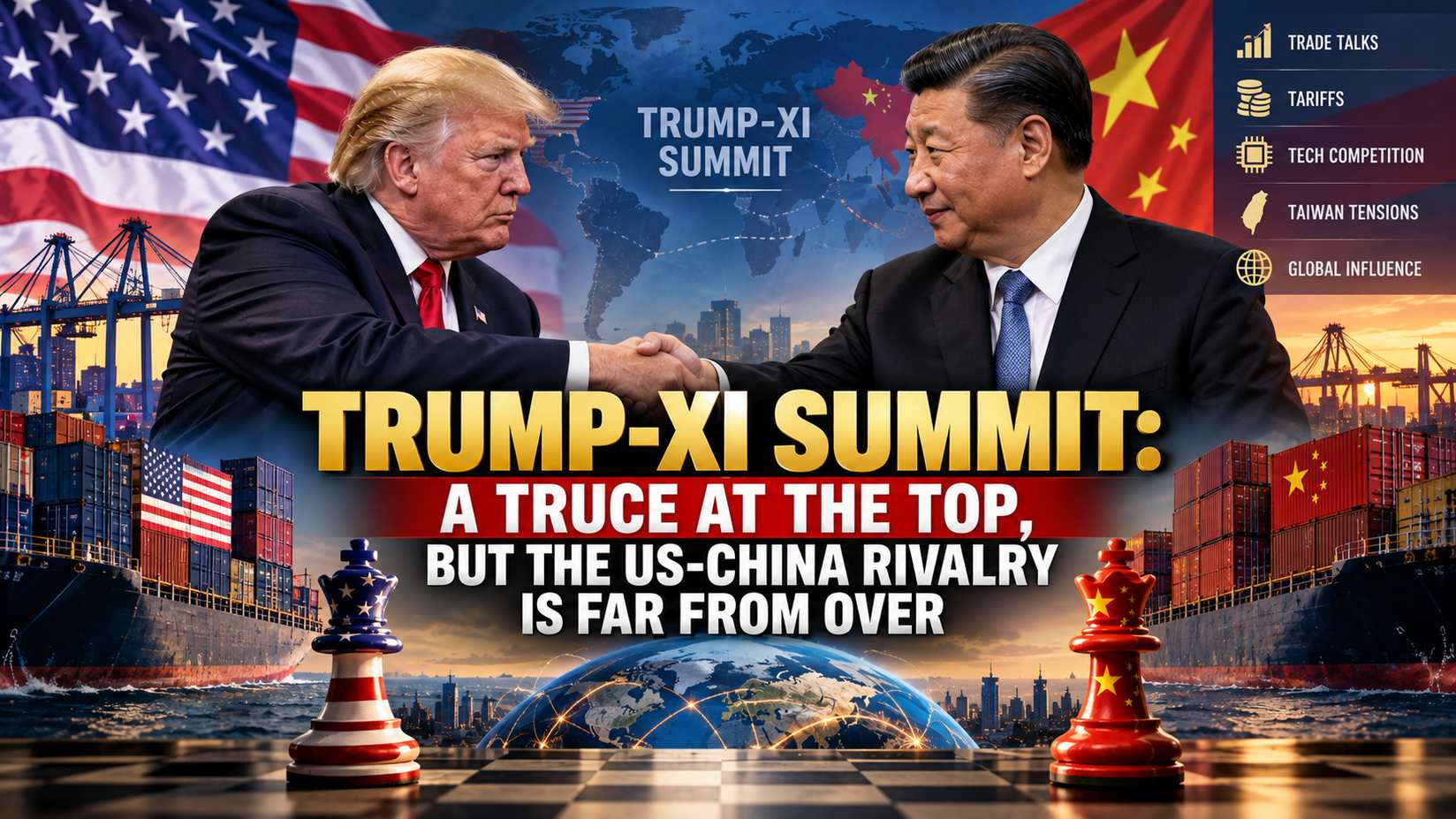
The White House meeting between Donald Trump and Xi Jinping produced warm handshakes, carefully chosen words and plenty of diplomatic ceremony.
But beneath the smiles was a much harder reality.
The United States and China remain locked in a competition over trade, Taiwan, artificial intelligence and technology. Their latest summit may have reduced the immediate risk of another economic confrontation, but it did not resolve the fundamental disagreements between the world’s two largest economies.
The clearest sign came from the trade agreement itself.
Washington and Beijing extended their existing trade truce by only two months, pushing difficult questions about tariffs, Chinese purchases, rare-earth supplies and technology restrictions into another round of negotiations.
So the summit was less a grand bargain than a pause.
And that may be precisely what both governments wanted.
The Warm Words Hid a Very Practical Calculation
Trump went out of his way to emphasize his relationship with Xi.
During the state dinner, he described the two countries as representing different systems but stressed the importance of their people-to-people ties and said the two leaders had “never gotten along better.”
Xi also called for a more stable relationship.
But diplomatic warmth should not be confused with strategic convergence.
Both leaders have powerful reasons to prevent their relationship from deteriorating further.
Trump faces an expensive war with Iran and other foreign-policy challenges.
China wants time to strengthen its economy, technology base and resilience while avoiding a damaging confrontation with Washington.
In that sense, stability is useful to both sides even while competition continues.
Trade: The Clock Has Been Reset, Not Stopped
Trade was expected to dominate the summit, and it did.
But the outcome was limited.
The existing trade truce has been extended for two months, giving negotiators additional time to work on a larger agreement.
That means businesses receive some additional breathing room.
But uncertainty remains.
Tariffs, Chinese purchases of American products, rare-earth supplies and technology restrictions are still unresolved.
China has also not completely delivered on all of its earlier purchasing commitments, according to U.S. officials.
For companies, that distinction matters.
A permanent agreement can support long-term investment decisions.
A temporary extension simply moves the deadline.
The trade war has therefore entered another holding pattern.
Rare Earths Give Beijing an Important Economic Lever
One of the most strategically important issues in the negotiations is rare earths.
These minerals are essential for a wide range of technologies, including electronics, electric vehicles, defense systems and advanced manufacturing.
China has enormous influence over global rare-earth processing and supply chains.
That gives Beijing leverage at precisely the moment Washington is trying to strengthen domestic manufacturing and reduce dependence on Chinese inputs.
The dispute therefore goes beyond tariffs on consumer products.
It is about who controls the industrial ingredients needed for the next generation of technology.
That makes the trade negotiations partly an economic discussion and partly a national-security discussion.
Taiwan Remains the Hardest Question
If trade is the issue both sides can temporarily postpone, Taiwan is the issue they cannot easily avoid.
Xi pressed Trump to handle the Taiwan question with what Beijing described as “prudence” and urged Washington to oppose Taiwan independence.
The United States, however, has maintained its longstanding policy framework toward Taiwan and has not announced a fundamental change in its position.
Washington is also legally committed to providing Taiwan with defensive capabilities.
That creates an inherent tension.
China wants greater limits on U.S. involvement with Taiwan.
The United States wants to preserve its ability to support Taiwan without formally recognizing the island as an independent state.
The summit did not remove that contradiction.
Trump’s Taiwan “Negotiating Chip” Is Still Being Watched
Trump has previously described a proposed U.S. arms package for Taiwan worth up to roughly $14 billion as a potential negotiating chip with Beijing.
That comment has generated concern among some officials and observers in Taiwan and Japan because it raises questions about whether Washington could use arms sales as leverage in broader negotiations with China.
But there was no indication from the summit that Trump had agreed to abandon U.S. arms support for Taiwan.
That distinction is important.
A negotiating position is not the same thing as a policy reversal.
For Beijing, however, even discussions about changing the pace or scale of U.S. arms sales can be politically significant.
AI Is Becoming the New Front Line
Artificial intelligence was another major issue at the summit.
And this may ultimately prove more consequential than traditional tariff disputes.
The United States and China are competing for leadership in advanced AI, semiconductor technology and computing power.
Washington has used export controls to restrict China’s access to some of the most advanced chips and technology.
Beijing argues that such restrictions are attempts to contain China’s technological development.
At the same time, both governments recognize that uncontrolled AI systems can create risks that cross national borders.
The two countries have discussed the possibility of mechanisms for AI dialogue and notification of serious AI-related incidents.
That creates an unusual situation.
Washington and Beijing are competing over who leads AI while simultaneously exploring whether they can cooperate on the risks created by the technology.
Xi’s “Thucydides Trap” Warning Matters
Xi used an especially revealing concept during the summit: the “Thucydides Trap.”
The term refers to the historical idea that competition between an established power and a rising power can increase the risk of conflict.
Xi’s use of the concept showed that Beijing views the U.S.-China relationship as something much larger than a dispute over tariffs.
China is now a technological, industrial and military competitor to the United States.
Washington, meanwhile, is trying to prevent China from gaining dominance in strategically important technologies.
That is why the relationship cannot be reduced to a trade negotiation.
The tariff dispute is only one layer of a much deeper competition.
Iran Adds Another Complication
The summit also took place while the United States remains involved in the prolonged Iran conflict.
Washington wants Beijing to use its influence with Tehran to help move the conflict toward negotiations.
China, however, has shown limited willingness to pressure Iran in ways that would serve U.S. objectives.
Reuters reported that China has continued significant trade with Iran, while U.S. officials have accused Chinese entities of helping Tehran evade sanctions. Beijing rejects such allegations.
This illustrates another problem for Washington.
The United States wants China’s cooperation on Iran.
China wants stable relations with Washington.
But that does not mean Beijing is prepared to adopt Washington’s strategy toward Tehran.
The Two Leaders May Need Each Other Without Trusting Each Other
This is perhaps the most important takeaway from the summit.
Trump and Xi do not need to become strategic partners to benefit from a period of calmer relations.
Trump can concentrate on other foreign-policy problems without opening another major economic confrontation with China.
Xi can use the breathing room to strengthen China’s domestic economy and technological capabilities.
That creates a limited area of common interest.
But beneath it, the competition continues.
The two countries still disagree over Taiwan.
They remain competitors in AI.
They are negotiating over tariffs and rare earths.
They are competing over advanced semiconductor technology.
And both are building economic and military resilience for a future in which the rivalry may become more intense.
The Summit Was About Managing Risk
It is tempting to judge a summit by whether it produces a historic agreement.
This meeting is better understood differently.
Its immediate purpose appears to have been preventing the relationship from getting worse while leaving the hardest disputes for later.
The two-month trade extension is evidence of that approach.
So is the emphasis on continued dialogue.
And so is the absence of a dramatic breakthrough on Taiwan or AI.
The leaders have not solved their differences.
They have created another window in which those differences can be managed.
What Comes Next Could Matter More Than What Happened in Washington
Trump and Xi are expected to have further opportunities to meet later this year, including at the APEC summit in Shenzhen and the G20 in Florida.
Those meetings could determine whether the temporary trade truce becomes a more durable arrangement or simply another pause before tensions return.
The bigger question will be whether the two countries can separate areas where cooperation is possible from areas where strategic competition is unavoidable.
That will be especially difficult in AI and Taiwan.
Trade disputes can be negotiated.
Technology restrictions can be adjusted.
But Taiwan involves military calculations, alliances and national identity.
AI involves economic power and national security at the same time.
Those are much harder problems.
A Pause, Not a Reset
The Trump-Xi summit produced something valuable but limited: another opportunity to keep the world’s most important bilateral relationship from sliding into a deeper confrontation.
The trade truce survives for now.
Communication remains open.
The leaders publicly emphasized cooperation.
But the underlying rivalry has not disappeared.
In fact, Xi’s warning about the “Thucydides Trap” highlighted exactly how deep the competition has become.
The real test will therefore come after the cameras leave the White House.
Can Washington and Beijing turn a temporary pause into a durable framework for managing competition?
Or will trade, Taiwan and AI eventually pull the relationship back toward confrontation?
For now, neither outcome is settled.
What the summit showed most clearly is that the United States and China are learning how to compete without allowing competition itself to become uncontrollable.